
The Digital Anthropometry behind Computer Vision
Learn how we combine the established US Navy method with geometric mapping of 2D contours to reduce human measurement variation and provide standardized body composition estimates.
Standardized Digital Circumference Measurement
The US Navy method is widely validated in scientific literature for using neck, waist and hip circumferences to estimate body density. However, a major practical challenge is variation in manual measurements between assessors or when measuring yourself with a tape.
The Manual Measurement Challenge
Patients or clients may apply different tape tensions, change their breathing or position the tape at the wrong anatomical height, creating misleading fluctuations in measurements.
The AI Solution
Our AI creates a two-dimensional contour map (Shape Analysis). By mathematically extracting body proportions from photos, the algorithm calibrates and corrects geometric distortions to provide a reproducible reference.
Step 1: The Ideal Photo Standard
For consistent AI recognition of body contours and anatomical landmarks, follow our posture, lighting and clothing guidelines when taking both patient photos.
Male Reference
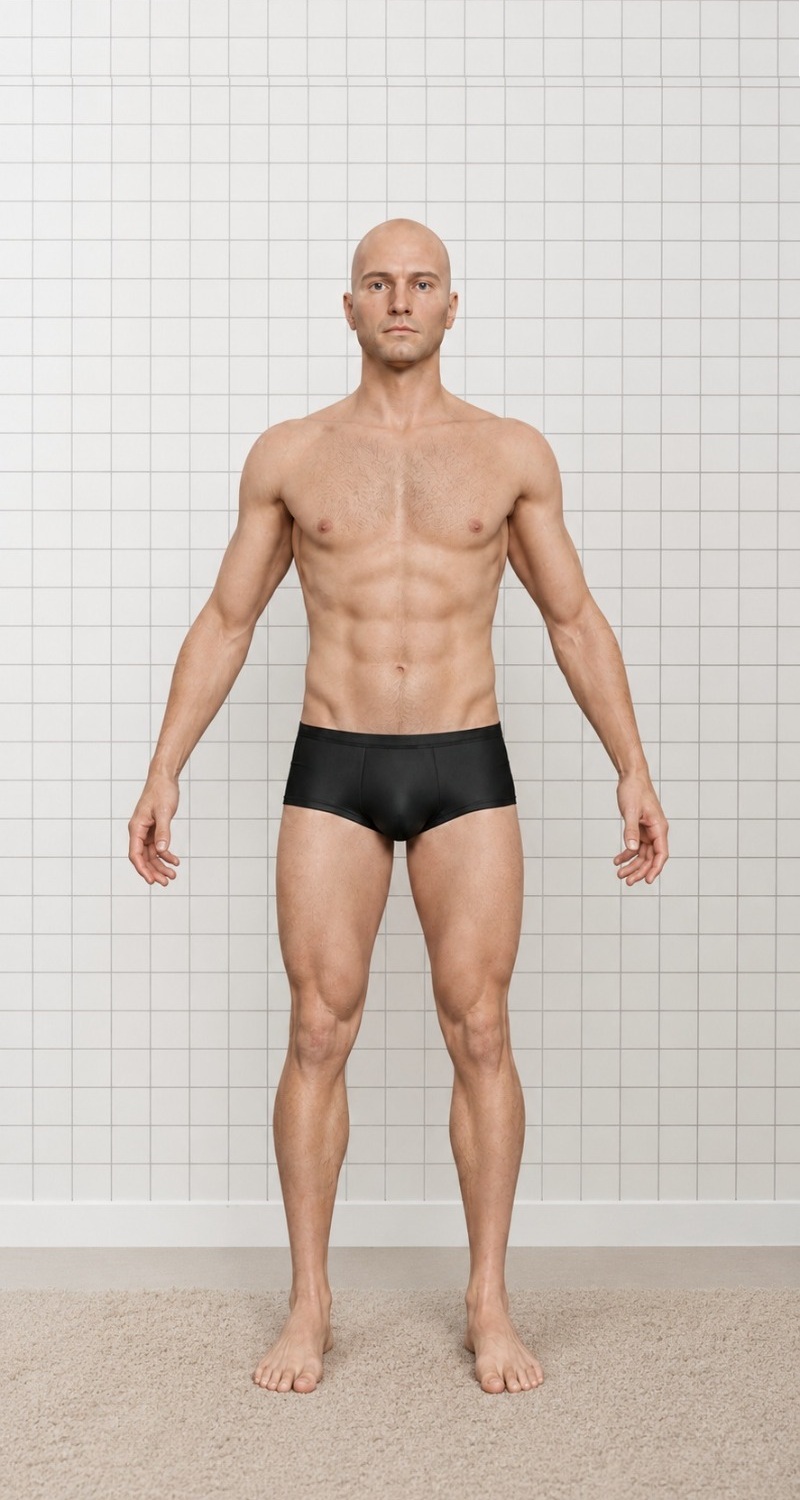 Front
Front Side
SideFemale Reference
 Front
Front Side
Side- Tie Back Your Hair: The neck must be fully visible in both front and side photos, with no hair covering the neck or shoulders.
- Keep Arms Slightly Apart: In the front photo, hands should not touch the legs. In the side photo, the arm follows the side of the body without crossing in front of the abdomen.
- Full-Body Framing: The photo must show the top of the head through the feet. The AI uses your height as its main scale reference (the feet determine the Z-axis for the mathematical modeling).
- Contrasting Clothing: Wear swim briefs or a bikini that contrasts with your skin. Avoid clothing that adds volume to the hips or covers the navel.
- Background and Lighting: Use a plain background (a white or solid-color wall), with no objects in the frame. Avoid harsh shadows from direct flash.
- Camera Position: Position the phone at waist or chest height and keep it straight (perpendicular to the floor). Avoid shooting upward from below: this angle distorts perspective, changes body proportions and causes the arms to overlap in the side photo.
Step 2: Fine Algorithm Calibration
With standardized photos submitted, AI automatically creates the contour and measurement lines in seconds. However, EvoluNutri IA is not a closed black box. The professional remains fully in control of the assessment and can review and refine the algorithm’s lines at any time. For precise manual adjustment, there is an essential geometric principle:

💡The Circle Center Rule
In the line editor (which supports 400% zoom), each line ends in a white circle . The AI calculations read the exact center of that circle as the physical boundary of the body measurement.
- Incorrect: Letting the outer edge of the circle touch the skin (this removes millimeters from the final calculation).
- Correct (Ideal Alignment): Drag the line until the CENTER of the circle rests exactly on the patient’s skin contour.

Perfect Alignment (400% Zoom)
🗺️The Complete Landmark Map
AI accuracy depends on reviewing all body lines, not just the neck. Below is the complete map of where each front and side line should be positioned:
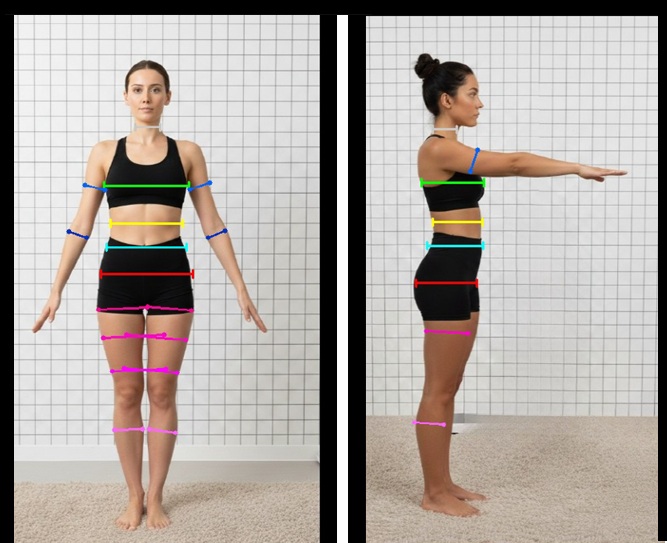
Reference: Female Anatomy
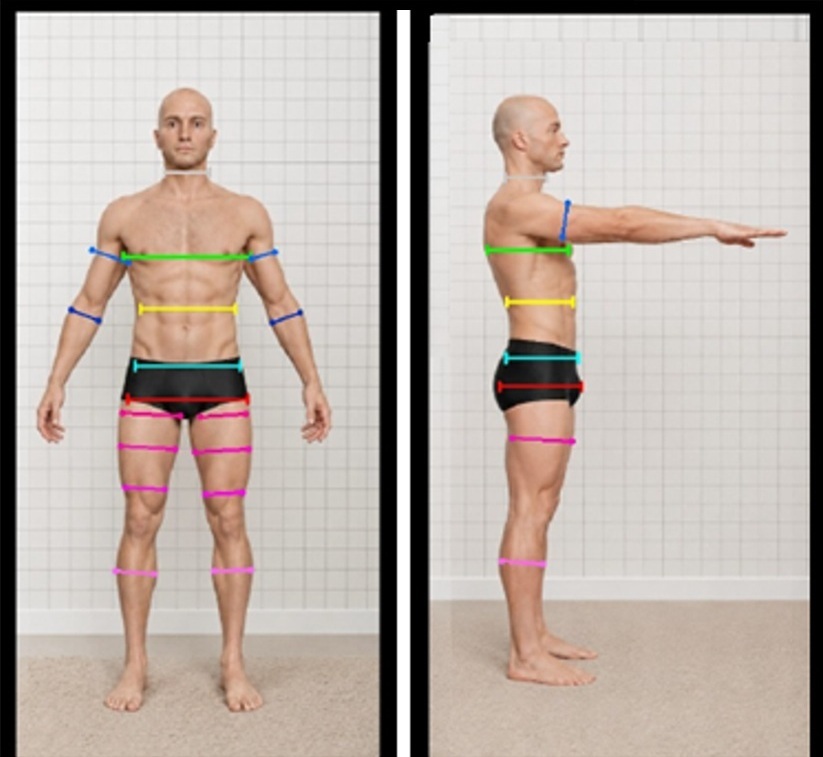
Reference: Male Anatomy
Scientific Foundations & Authorship
Bibliographic References
- Hodgdon, J. A., & Beckett, M. B. (1984). Prediction of percent body fat for US Navy men and women from body circumferences. Naval Health Research Center San Diego CA.
- Siri, W. E. (1961). Body composition from fluid spaces and density: analysis of methods. Techniques for measuring body composition, 223-244.
- Madrigal, A., et al. (2020). Validation of 3D optical body scanning for body composition assessment in clinical settings. Journal of Digital Health and Anthropology.
Development & Technical Authorship
Technical content and model architecture developed by Márcio Wandré Morais de Oliveira, a chemist with a master’s degree from the University of Brasília (UnB) and founder of EvoluNutri IA.
Disclaimer and Clinical Use: EvoluNutri IA estimates are a complementary tool for anthropometric monitoring and body progress tracking. They do not replace a clinical diagnosis by a nutritionist or physician. Results may vary with posture, lighting, clothing and photo framing.